
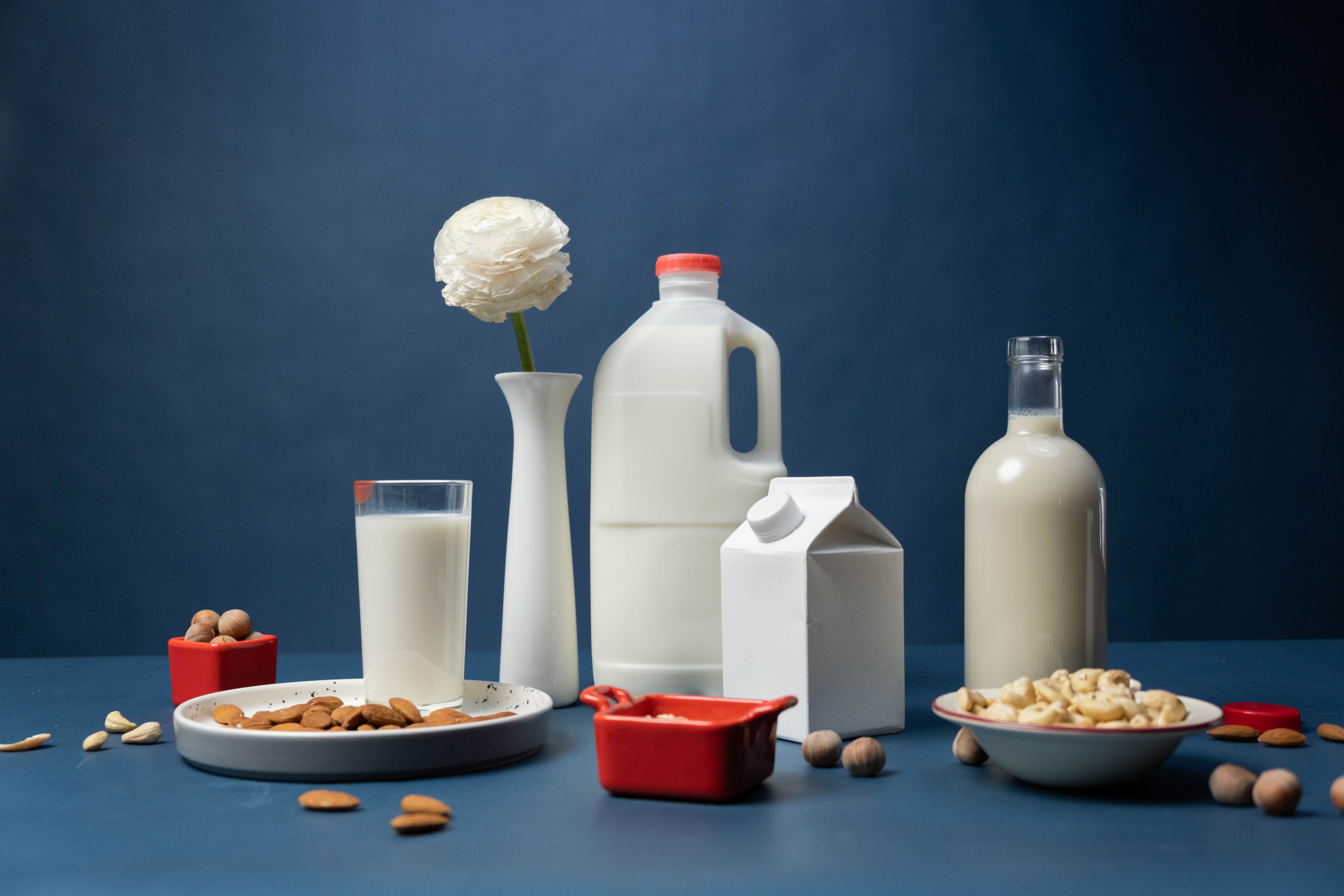
Why Does Plant-Based Milk Separate? How Commercial Brands Improve Stability and Mouthfeel
SUBSCRIBE TO OUR BLOG
Promotions, new products, and recipes.
Key Takeaways
-
Plant-based milks separate because ground nuts, oats, and seeds do not dissolve in water but float, so gravity slowly separates them by size and density.
-
There are two types of separation: sedimentation (grit sinking) and creaming (fat rising), which are both accelerated by a thin liquid.
-
Cape Crystal Brands hydrocolloids collection (lambda carrageenan, tara gum, locust bean gum, and xanthan gum) is used to thicken the water and keep particles in place, usually at 0.05% to 0.6% of the weight.
-
Commercial brands often combine fine grinding, homogenization, heat treatment, and a little gum; you can apply the same for a home-based recipe on a smaller scale.
A carton of almond milk may appear smooth on the shelf, but the first pour reveals some pale flecks floating in the cup and a chalky layer stuck at the bottom. It gets even worse when you mix the milk with hot coffee, because the texture turns thin and gritty just when you were waiting for that first creamy sip.
In most cases, the cause is inherent in the process of making the plant-based milk, but you can also attribute it to poor ingredients, a bad batch, or a recipe error. For starters, it’s easy to make a creamy, protein-rich plant-based milk at home by blending raw groundnuts, oats, or beans with water. However, these products do not dissolve in water, meaning they’ll separate over time.
So, if you have ever wondered why plant-based milk separates, here's why: The short answer is that the beverage is a suspension and emulsion rather than a completely dissolved solution. The good news is that manufacturers can significantly slow these physical changes by controlling particle size, viscosity, droplet size, processing conditions, and stabilizer selection.
Understanding exactly how and why these changes occur is the first step toward preventing them, so let's break down what is happening inside the carton and how the right ingredients and techniques can keep every pour smooth and creamy.
Table of Contents
-
Why Does Plant-Based Milk Separate?
-
What Stabilizers Are Used in Plant-Based Milk?
-
How Do Commercial Brands Improve Plant Milk Stability?
-
How Can You Make Plant-Based Milk Creamier?
-
Mistakes That Can Bring Back Separation
-
What to Try in Your Next Batch
-
Frequently Asked Questions
- Give Your Plant-Based Milk the Stability It Needs
Why Does Plant-Based Milk Separate?
Milk from an animal such as a cow has a naturally complex structure that helps keep its fat and protein dispersed. Plant-based milk does not have the same casein-based system. A 2025 review by Massey University researchers found that their colloidal stability is lower than that of cow milk, which can lead to sedimentation, creaming, and other forms of phase separation.
The underlying production process seems simple enough: You grind raw material such as oats or almonds with water and strain it. What passes through is a mix of dissolved sugars, tiny protein clumps, oil droplets, and bits of cell wall, all sitting loosely in water. Because each piece is unique in size and density, gravity separates them at different rates.
What Causes Sedimentation in Plant-Based Milk?
Sedimentation occurs when particles in the beverage are denser than the surrounding liquid and gradually settle. In oat milk, starch and fiber fragments can contribute to sedimentation. In soy beverages, protein aggregates may be the sole contributor. Almond milks can contain fine nut solids, while fortified products may contain added mineral particles such as calcium salts.
Here, three things set the tempo. Larger particles fall faster; a greater density difference between the particle and the water speeds things up, while a thin liquid offers little resistance to sedimentation. This is best described by physicists using Stokes' law, which accounts for the fact that finer grinding and a thicker liquid both slow the rate at which a liquid settles.
Why a Cream Layer Forms On Top

Besides sedimentation, plant-based milk is also prone to creaming. Oil particles in the raw material are less dense than water, so they float to the surface and accumulate there. Coconut, cashew, and almond-based milk drinks do this most noticeably.
Particles that collide can coalesce, with larger droplets rising faster than smaller ones. This means that once coalescence begins, a visible cream layer can develop more quickly.
Acids and minerals don't help either. As plant proteins that are still present in the milk interact with the acid and heat from the coffee, they tend to curdle, which is why you might have started with a nice coffee but finished with a lumpy latte.
How Separation Changes Mouthfeel
Mouthfeel is the physical sensation of a drink in the mouth, and separation affects it in quite a noticeable manner. As the solids sink, the top of the carton becomes watery, and the bottom becomes gritty, and no single pour will taste as the recipe intended.
A thicker liquid remains in the mouth longer, which is why a properly gummed drink feels fuller than a thin one with the same amount of fat. Droplet size also influences mouthfeel: small droplets form a smooth film, whereas large droplets feel oily in one area and watery in the next.
What Stabilizers Are Used In Plant-Based Milk?
Most stabilizers are in a family known as hydrocolloids, which are actually plant and seaweed powders that thicken water and help hold particulates together. The ones formulators use most often are carrageenan, gellan gum, locust bean gum, tara gum, guar gum, and xanthan gum.
A small amount of an emulsifier, such as sunflower lecithin, is usually added to them to help prevent oil droplets from merging. You only need a small amount of each stabilizer, with most recipes ranging from 0.05% to 0.6% of the total weight, depending on the gum.

Can Lambda Carrageenan Be Used In Plant-Based Milk?
Yes, and it suits the job better than kappa and iota carrageenan, which are known to form gels. For home formulators who want to test this approach, Cape Crystal Brands lambda carrageenan is a good option for adding viscosity and creaminess to plant-based beverages without creating a firm gel. Its typical use runs from 0.1% to 0.5% by weight, and you can also pair it with xanthan gum to improve particle suspension.
Lambda carrageenan's deeply mysterious reputation also means you need to understand how to use it safely. The FDA permits it as a food additive under 21 CFR 172.620, and food-grade carrageenan is a different material from poligeenan, which is not approved for food.
Can Tara Gum Improve Plant-Based Milk Texture?
Yes, it can. Tara gum is derived from the seeds of the Tara tree, which is native to Peru, and is in the same family as guar gum and locust bean gum. If you want to experiment with tara gum specifically, you can use Cape Crystal Brands tara gum powder as a starting ingredient for formulations where you want smoother viscosity and body without an overly heavy or gummy texture.
But unlike guar gum, which hydrates readily in cold liquid but can feel slick when used heavily, tara gum often adds a soft, rounded thickness without the slightly slimy mouthfeel. It is also flavor-neutral, which is important, especially when an almond drink should taste like almonds.
Tara gum can also help reduce water separation. Typical usage levels are around 0.1% to 0.5% by weight, although the right amount depends on the specific formulation and should ideally be determined through testing.
Can Locust Bean Gum Be Used In Plant-Based Beverages?
Yes. Locust bean gum, also called carob gum, comes from carob seeds. It gives a creamy body, improves suspension, and holds water in place. Typical use is 0.2% to 0.6% by weight.
It requires about 85 to 90°C (185 to 194°F) and vigorous stirring to fully rehydrate. Skip that step, and the beverage becomes grainy or spotted. It works best in pairs. With xanthan gum, it creates an elastic network that can provide a fuller, more fat-like texture to oat and almond milk.
For home testing, Cape Crystal Brands offers both individual locust bean gum and xanthan gum, as well as a xanthan gum + locust bean gum kit, making it easier to test the combination without sourcing the two ingredients separately.
How Do Commercial Brands Improve Plant Milk Stability?
A carton that remains uniform for months is rarely the result of one ingredient. Commercial manufacturers typically combine several processing and formulation strategies, each addressing a different part of the stability problem.
-
Fine Grinding & Filtration: These processes break down coarse particles to minimize their settling.
-
High-pressure Homogenization: Breaks clusters and any droplets so that they are smaller and better spread out. The smaller droplets have less velocity and are less prone to separating quickly.
-
Enzyme Treatment for Oat Beverages: Enzymes are used to convert starch molecules to prevent heavy and unstable oat beverages.
-
Protein and Mineral Control: Buffering agents and pH adjusters, such as sodium citrate, can help manage protein issues when combined with minerals or acids.
-
Gum Blends: Different hydrocolloids help control calcium, improve body, reduce sedimentation, and create a more consistent mouthfeel.
How Can You Make Plant-Based Milk Creamier?
Creaminess in plant-based milk comes from thickness, tiny droplets, and a little fat. All of that can be controlled in a home kitchen if you adhere to the following:
-
Reduce Water Content: A greater proportion of nuts, oats, or seeds means more solids and a fuller body.
-
Strain and Blend for Longer Through a Fine Cloth: Smaller particles have a much softer texture and are more likely to settle slowly.
-
Consider Fat and Emulsification: A teaspoon of cashew butter or oil combined with a bit of lecithin will keep the droplets separated.
-
Hydrate Properly: Combine the powder with some sugar or a dry ingredient, then add it while blending at high speed. Always use low heat for tara or locust bean gum.
If you’re unsure which gum suits your homemade plant-based milk recipe, the Cape Crystal Brands hydrocolloid selector can help you compare different options before ordering and testing an ingredient.
Mistakes That Can Bring Back Separation

Watch out for these simple mistakes to avoid separation in your plant-based milk recipes at home.
-
Adding Gum Powder All At Once: This can produce hydrated lumps with dry centers. Introduce it gradually while mixing vigorously instead.
-
Assuming More Gum Means More Creaminess: Too much hydrocolloid can make a drink feel gummy, slick, or unnecessarily heavy rather than rich.
-
Ignoring Hydration Temperature: This is particularly important with locust bean gum. If it has not hydrated properly, simply increasing the dosage is unlikely to solve the underlying problem.
-
Changing Several Ingredients at Once: When testing a new formulation, change one major variable at a time and record the result. Otherwise, it becomes difficult to know which adjustment actually made the difference.
What to Try in Your Next Batch
Separation is not a defect in the recipe. It's just physics, and you have three levers to respond with: smaller particles, a thicker liquid, and keeping droplets apart.
Commercial manufacturers manage these variables through fine milling, filtration, homogenization, heat treatment, emulsification, and carefully designed stabilizer blends. A home batch can mimic their work with a good blender, a gram scale, and one or two gums.
A decent first shot could be a liter of almond or oat milk with a touch of lambda-carrageenan at 0.2%, and a bit of xanthan gum for suspension. If you're looking for something more substantial, you might add Tara gum or locust bean gum, which sit alongside other candidates in a grocery aisle full of food stabilizers.
Frequently Asked Questions
1. Why does plant-based milk separate after sitting?
Plant-based milk can separate because it is composed of water, oil, protein, starch, and plant matter, all of which have different physical characteristics. In the meantime, heavier particles may settle, and oil droplets may rise. Homogenization, emulsifiers, and stabilizers slow these processes and help the beverage remain more uniform during storage.
2. What causes sedimentation in plant-based milk?
One common cause is large or poorly distributed plant particles. Particles may flow more easily through the liquid when the viscosity is low. You can reduce sedimentation by using hydrocolloids to increase viscosity and suspend particles.
3. What stabilizers are used in plant-based milk?
Lambda carrageenan, Tara gum, locust bean gum, xanthan gum, guar gum, and gellan gum are all common stabilizers used in plant-based milk. While some help with suspension, body, mouthfeel, or interactions with other hydrocolloids, others primarily increase viscosity.
4. Can lambda-carrageenan be used in plant-based milk?
Yes, when a formulation needs more viscosity, suspension, and a smoother mouthfeel without creating a hard gel, lambda-carrageenan can be used in plant-based milk. You can also mix it with hydrocolloids to obtain a particular texture and stability profile.
5. How can you make plant-based milk creamier?
A creamy plant-based beverage generally depends on several factors working together: effective emulsification, appropriate particle size, sufficient viscosity, and a suitable stabilizer system. Tara gum and locust bean gum can contribute body, while lambda carrageenan can increase viscosity without producing a firm gel.
Give Your Plant-Based Milk the Stability It Needs
Plant-based milk doesn’t have to separate shortly after, be watery at the top, or settle at the bottom. Once you know what is going on inside the drink, making it better textured is a lot easier. One of the best approaches that’ll get you the optimal results is to look at the whole formulation rather than rely on one ingredient.
If you’re looking for the right ingredient for your formulation, Cape Crystal Brands offers food-grade hydrocolloids and stabilizers, including lambda carrageenan, tara gum, locust bean gum, and xanthan gum. These give you several options for adjusting viscosity, suspension, and mouthfeel depending on what your plant-based milk needs.

|
About the Author Ed is the founder of Cape Crystal Brands, editor of the Beginner’s Guide to Hydrocolloids, and a passionate advocate for making food science accessible to all. Discover premium ingredients, expert resources, and free formulation tools at capecrystalbrands.com/tools. — Ed |

The Story Behind The Genuine Carroway Cookbook and Island Advice Journal

How Small Ingredient Choices Quietly Change Appetite, Digestion, and Satisfaction
When Clean Labels Still Produce Unsettling Food
Enjoyed this post? Subscribe to The Crystal Scoop
Food-science tips, ingredient know-how, and recipes. No spam—unsubscribe anytime.
- Choosing a selection results in a full page refresh.