

Why Ultra Processed Foods Feel Hollow, Not Just Unhealthy
SUBSCRIBE TO OUR BLOG
Promotions, new products, and recipes.
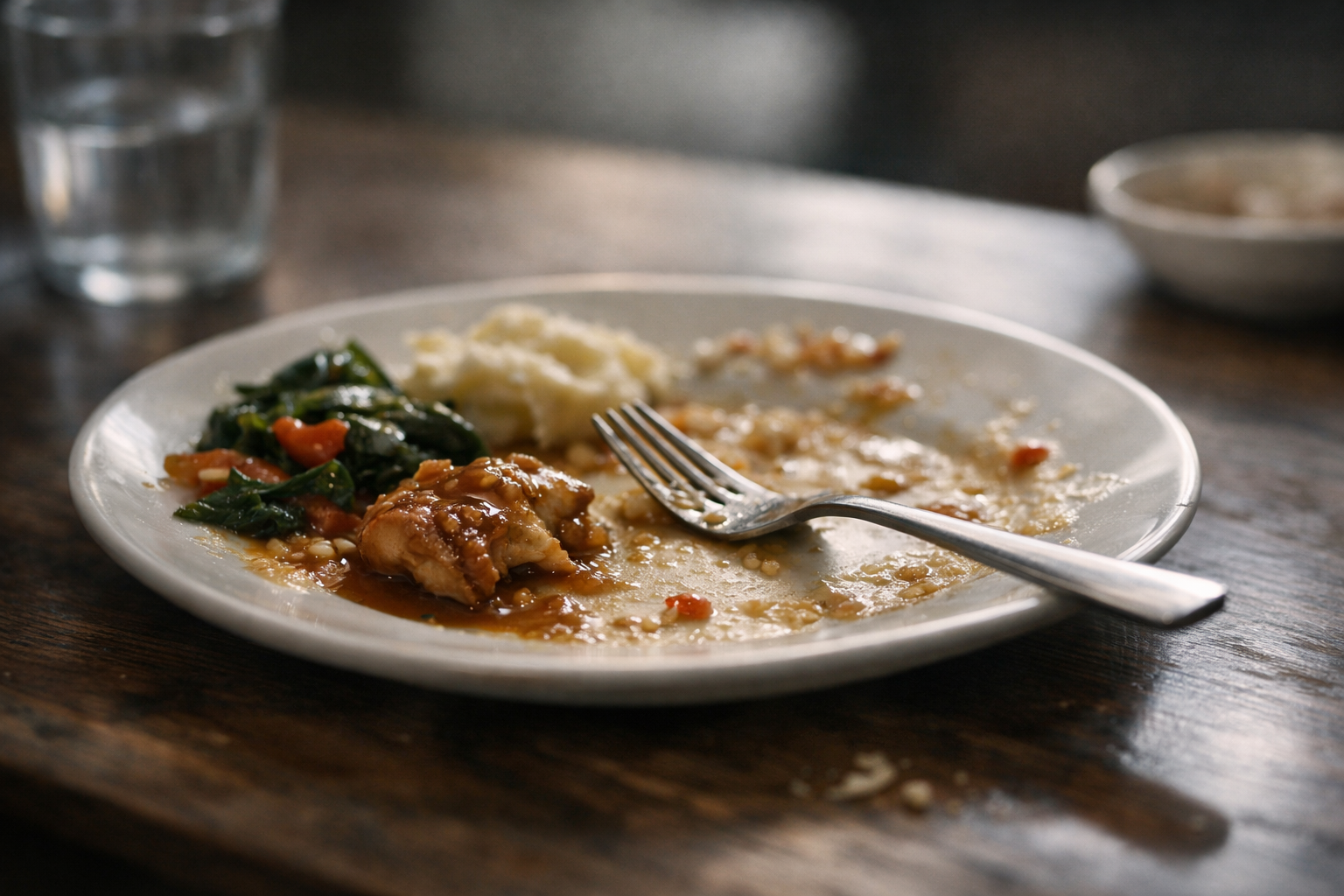
You finish eating, but something doesn’t close.
The plate is empty. The flavor was loud enough. There was sweetness, or salt, or heat, whatever was promised arrived on cue. And yet your body lingers in a strange in between. Not hungry, exactly. Not satisfied either. Just… unresolved.
It’s an oddly modern sensation. Our grandparents had words for “too full” and “still hungry.” We seem to have acquired a third state: fed, but hollow.
That word hollow doesn’t point to nutrition. It isn’t about whether something is “good” or “bad.” It describes a physical experience. A lack of density. A missing weight. As if the food passed through without ever fully arriving.
You notice it most with foods that are easy to eat quickly. They break apart without resistance. They dissolve rather than require chewing. They bloom with flavor immediately, then vanish. Your jaw barely works. Your tongue does most of the labor.
At first, that feels like efficiency. Then, after a while, it starts to feel like absence.
There is a quiet contradiction here. These foods are engineered to be intensely flavorful. They are designed to be irresistible. And yet the more vividly they announce themselves at the start, the less they seem to linger at the end.
It is not a failure of taste. It’s a failure of structure.
Structure is what gives food a kind of physical argument. It’s the resistance you push against with your teeth. The internal structure that holds something together just long enough for your mouth to read it as substantial. When that scaffolding is thin, fragmented, or overly uniform, the experience collapses in on itself.
Think about how some foods fracture. They shatter cleanly, almost theatrically. The sound is impressive, but the pieces are light. They don’t demand much from you. They’re gone before your body has fully registered what happened.
Contrast that with something that yields slowly. Something fibrous or layered. Something that changes texture as you chew. There is friction, variation. There’s time.
Time is the part we don’t talk about enough.
When food disappears too quickly, when it requires minimal chewing, minimal pause, your body receives fewer signals along the way.
Satiety isn’t just about what’s in the food. It’s a mechanical dialogue between mouth, jaw, stomach, and brain. The longer that conversation lasts, the more complete it feels.
Ultra processed foods often shorten that conversation. Not maliciously. Not morally. Structurally.
They are frequently built from components that have been separated, refined, and reassembled into something uniform. Uniformity makes them predictable. Predictability makes them easy to eat. Ease reduces friction. Reduced friction shortens the eating event.
And a shortened event can feel strangely incomplete.
There’s also the matter of density not caloric density, but physical density. Some foods feel substantial in your hand. They have weight relative to their volume. Others feel almost aerodynamic. Light, puffed, expanded. You can eat a large quantity without sensing much mass.
That lightness can create a sensory mismatch. Your eyes register volume. Your mouth registers flavor. But your body registers very little resistance and very little weight. The signals don’t quite align.
This mismatch is part of what creates the hollow feeling. It’s not that the food lacks energy. It’s that it lacks structural presence.
Flavor, meanwhile, has been amplified. Loud flavor can briefly simulate depth. Strong seasoning, sharp flashes of sweetness or salt, and precisely engineered aromas deliver a striking first impression. But flavor without structure is like a soundtrack without a film. It fills the air, then fades.
There is a moment, often subtle, when chewing shifts from exploration to repetition. The texture does not change much. It doesn’t evolve. It simply diminishes. The food becomes paste-like or dissolves entirely. Your mouth is left moving without new information.
That plateau is telling.
Foods with more intact structure tend to unfold. They might start firm and soften gradually. They might release moisture slowly. They might reveal slight variations from one bite to the next. This variability keeps your senses engaged long enough for fullness to feel earned.
When everything is uniform, same crunch, same softness, same rapid dissolve, your body finishes the mechanical work quickly. The sensory arc is short. There’s no middle chapter.
This is part of why some meals feel like events and others feel like interruptions. An event has phases: anticipation, engagement, resolution. An interruption is over almost as soon as it begins.
Ultra processed foods often behave like interruptions.
They also tend to minimize what could be called structural friction. Friction isn’t a flaw. It’s the mild resistance that requires effort, chewing, tearing, breaking down. That effort is not just mechanical; it’s communicative. It gives your nervous system time to calibrate.
Without friction, food becomes frictionless fuel. Smooth, efficient, rapidly consumed. Efficiency sounds virtuous in most contexts. In eating, it can feel oddly empty.
There’s another dimension to this sense of hollowness: the way these foods are constructed. When components are broken down into their functional parts and then recombined, the resulting structure can be precise but thin. It holds together just enough to maintain shape, then disintegrates exactly on schedule.
This precision is impressive. It’s also part of the problem.
Natural structures are messy. They contain irregularities, unpredictable density, slight inconsistencies. That messiness creates micro surprises in the mouth. Small shifts in resistance. Subtle changes in texture. Those shifts extend the eating experience and deepen the sense of contact.
Reassembled structures tend toward sameness. Each bite mirrors the last. There’s a kind of engineered smoothness to the experience. Smoothness, again, feels pleasant at first. But over time, it flattens.
If you pay attention, the hollow feeling often arrives not during the first few bites, but afterward. It’s a delayed recognition. Your mouth was entertained. Your stomach received volume. But something in between never quite connected.
You might find yourself reaching for more not because you’re starving, but because the first round never resolved. The flavor arc ended abruptly. The structural conversation was too brief. The body, still waiting for closure, asks for a repeat.
This is where the discussion often drifts into morality. Into warnings. Into advice. But the phenomenon itself doesn’t require that framing. It’s simply an observation about form.
In an earlier reflection on how texture shapes satiety, the focus was on chewing as a kind of pacing mechanism. The same principle is at work here, but magnified. When texture becomes secondary to flavor, the pacing collapses.
Hollowness isn’t a moral verdict. It’s a structural outcome.
It’s what happens when flavor is concentrated and structure is thinned. When volume expands but density drops. When friction is engineered away. When eating becomes fast, uniform, and acoustically dramatic but mechanically light.
None of this makes a food evil. It makes it brief.
And brief experiences rarely feel complete.
Once you start noticing this, it’s hard to ignore. The next time something tastes vivid but leaves you oddly unsatisfied, you may catch the missing piece. Not a nutrient. Not a virtue. Just a lack of structural depth.
The food arrived loudly. It just didn’t stay long enough to feel real.
And fragile things break quickly.
The Science of Satiety & Structure
Master the hidden physics and chemistry of your kitchen with Ed McCormick.
- → Meet the Expert: About Ed McCormick
- Part 1: Why Some Foods Never Feel Filling
- Part 2: Silent Architects: Texture, Structure, and Satiety
- Part 3: Why Food Tastes Fine But Feels Wrong
- Part 4: Mouthfeel: Brain vs. Tongue Satisfaction
- Part 5: The Hidden Role of Structure in Blood Sugar Spikes and Crashes

|
About the Author Ed is the founder of Cape Crystal Brands, editor of the Beginner’s Guide to Hydrocolloids, and a passionate advocate for making food science accessible to all. Discover premium ingredients, expert resources, and free formulation tools at capecrystalbrands.com/tools. — Ed |

The Story Behind The Genuine Carroway Cookbook and Island Advice Journal
How Small Ingredient Choices Quietly Change Appetite, Digestion, and Satisfaction
When Clean Labels Still Produce Unsettling Food
Enjoyed this post? Subscribe to The Crystal Scoop
Food-science tips, ingredient know-how, and recipes. No spam—unsubscribe anytime.
- Choosing a selection results in a full page refresh.