
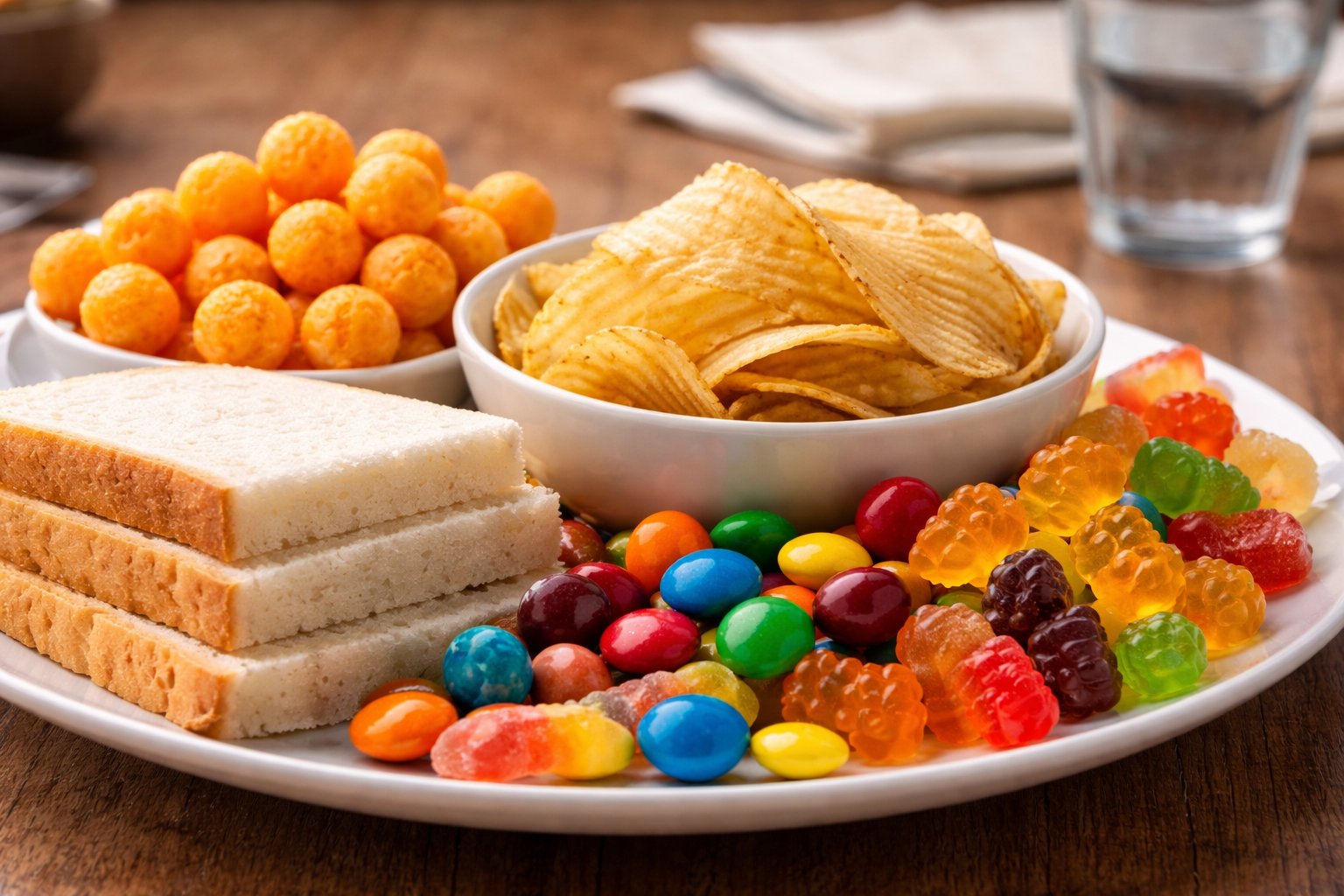
Why Some Foods Never Feel Filling (Even When the Calories Say They Should)
SUBSCRIBE TO OUR BLOG
Promotions, new products, and recipes.
You can finish a meal, push the plate away, and feel… nothing. Not hungry exactly. Not satisfied either. The stomach isn’t empty, but the experience feels incomplete, like a sentence that stopped halfway through.
This happens most often with foods that behave politely. They go down easily. They don’t resist. They don’t ask much of your mouth or your attention. You can eat a surprising amount of them without feeling full in the way you expect fullness to arrive. Later, you might even check the numbers and feel briefly confused. By that accounting, the meal should have been enough.
The quiet tension is that “enough” is doing two jobs at once. One is mathematics. The other is experiential. And those two don’t always agree.
Most of us learn fullness as a sensation long before we learn it as a concept. As children, we stop eating not when we calculate anything, but when the body signals that something has been completed. The signals are layered: stretch, warmth, tempo, resistance, time. They arrive gradually, often late. When they do arrive, they don’t say “stop now.” They say, “something has happened.”
Certain foods interrupt that process without feeling disruptive. They compress the experience of eating. The mouth moves quickly. The swallow comes early. The body receives energy before it has received much information. The meal finishes before the body has finished noticing it.
This is where the mismatch begins. Fullness isn’t just the presence of energy. It’s the accumulation of signals that tells the body how that energy arrived.
Consider how rarely we talk about chewing unless something goes wrong. We treat it as a mechanical step, not a sensory one. But chewing is one of the main ways food announces itself. It creates duration. It creates friction. It forces attention, even when we’re distracted. When chewing disappears or becomes trivial, the body loses a key measure of scale. The meal still counts, but it doesn’t register.
Texture plays a similar role. Foods that change shape as you eat them, breaking, resisting, and yielding in stages, create a sense of progression. You don’t just consume them. You move through them. Foods that don’t change much from first bite to last can feel strangely flat, even when they are abundant. The body experiences volume without narrative.
There’s also temperature, which we tend to notice only at the extremes. Warmth spreads. Cold lingers. These changes unfold over time, and time matters. Fullness is partly a memory of duration. If the meal passes too quickly, the body keeps waiting for the rest of it.
None of this is about virtue or restraint. It’s about structure. Some foods arrive as events. Others arrive as data. The body is fluent in both, but it trusts the former more.
This helps explain why two meals that “add up” the same way can feel so different afterward. One leaves a sense of closure. The other leaves a low-level restlessness, as if the meal never quite landed. People often describe this as craving, but craving implies desire for more. What’s happening here is closer to unfinished business.
The body is especially sensitive to the pace at which things happen. Rapid intake creates a delay between action and sensation. By the time fullness begins to assemble, the eating is already over. Slower, more resistant foods stretch the experience so that sensation and action overlap. Fullness doesn’t arrive as an afterthought. It arrives as a companion.
There is a useful way to think about this that doesn’t involve rules or improvement. Imagine that the body is less interested in totals than in trajectories. It’s tracking how something unfolds. Does it build? Does it change? Does it require adjustment? When food provides very little variation, the trajectory is too smooth. The body receives the endpoint without the journey.
This may be why some foods feel curiously “invisible” once eaten. You know you ate them. You might even feel physically heavy. But the internal sense of having participated in a meal is missing. The experience slips out of memory quickly, which can make the absence feel sharper.
There’s a small body of work on how these signals integrate, how mechanical effort, time, and sensory feedback combine to produce what we casually call satiety, but it’s rarely discussed outside technical contexts. A brief overview lives quietly here, if you’re curious. You don’t need it to notice the effect; most people already have.
It’s interesting how small the change can be. Add a bit of resistance, a short delay, or some variation, and the same amount of food suddenly feels grounded. Remove those things, and the experience thins out. Nothing dramatic happens. There’s no warning. Just a sense, afterward, that the meal didn’t quite touch the sides.
Modern food environments are very good at delivering energy cleanly and efficiently. They’re less consistent at delivering the signals that tell the body a meal has taken place. When those signals are faint, the body doesn’t panic. It just keeps listening.
This is why the question “why doesn’t this feel filling?” often lingers longer than hunger itself. It’s not dissatisfaction in the usual sense. It’s a mismatch between what the body received and what it was prepared to recognize.
Once you notice this, it is hard to unnoticed. You start to feel the difference between eating that happens to you and eating that you move through. Between meals that arrive all at once and meals that unfold. The distinction isn’t moral or even practical. It’s perceptual.
Some foods leave you fed. Others leave you finished. The difference isn’t always visible on the plate, but the body feels it immediately and keeps feeling it long after the meal is over.
The Hidden Architecture of Food
A 12-Part Series on Why We Eat What We Feel — by Ed McCormick
- Meet the Expert: About Ed McCormick
- 01: Why Some Foods Never Feel Filling
- 02: Silent Architects: Texture, Structure, and Satiety
- 03: Why Food Tastes Fine But Feels Wrong
- 04: Mouthfeel: Brain vs. Tongue Satisfaction
- Coming Soon:
- 05: The Physics of Emulsions | 06: Gelling and Fluid Dynamics | 07: The Suspension Secret | 08: Modern Baking Chemistry... and more.

|
About the Author Ed is the founder of Cape Crystal Brands, editor of the Beginner’s Guide to Hydrocolloids, and a passionate advocate for making food science accessible to all. Discover premium ingredients, expert resources, and free formulation tools at capecrystalbrands.com/tools. — Ed |
When Clean Labels Still Produce Unsettling Food
The Texture Gap: Why Homemade Food Feels Different Than Packaged Food

Hydrocolloids Explained: Food Gums, Gels and Texture
Enjoyed this post? Subscribe to The Crystal Scoop
Food-science tips, ingredient know-how, and recipes. No spam—unsubscribe anytime.
- Choosing a selection results in a full page refresh.