
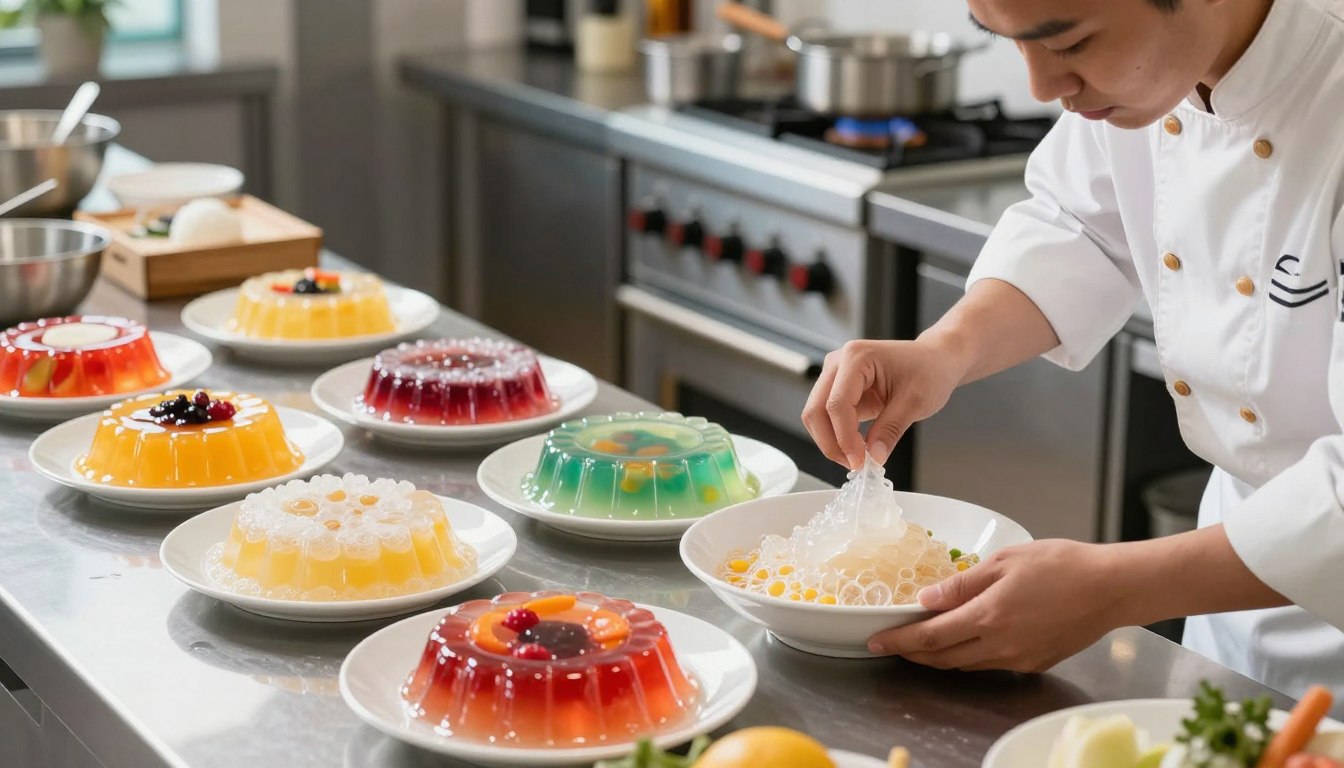
Performance of Agar Agar in High-Temperature Food Preparations
SUBSCRIBE TO OUR BLOG
Promotions, new products, and recipes.
Can a natural gel ingredient withstand food processing temperatures? Agar Agar is extracted from red seaweed. It is utilized in the food industry to thicken, mix, and gel food. It can alter food texture without tampering with taste and aroma.
Since more people require processed food, understanding how agar agar performs in hot conditions is important. Does agar agar remain strong and effective, or does it degrade? Examining how agar agar performs in a hot environment will enable us to determine if agar agar is effective for food preparation on a massive scale.
Key Takeaways
-
Natural origin of Agar Agar as well as its uses.
-
The significance of knowledge about the properties of agar agar when exposed to high temperatures.
-
Possible consequences of high temperature on the stability and efficacy of agar agar.
-
Consequences related to the processing of industrial foods.
-
Information on using agar agar in different high-temperature processes.
What is Agar Agar?
Agar-agar is derived from a type of algae found in the sea. It is very important in traditional food systems as well as in modern food systems. Agar-agar is derived from the cell walls of red algae, which include Gelidium and Gracilaria.
Origin and Composition of Agar Agar Powder
Agar agar has two components: agarose and agaropectin. These aid in its conversion to gel. The ratio can be varied depending on its source as well as its processing methods. Agar agar is made by obtaining the parts from red algae. They are then cleaned and dried to obtain agar-agar powder, which is an off-white powder with no smell or flavor.
Chemical Structure and Natural Properties
The composition of agar agar is unique in its own way. It has both agarose and agaropectin. These give it its gel form and influence its melting point, respectively. It is the unique composition of agar agar that gives it the ability to form a strong gel at a normal temperature.
Usual Gelling Characteristics at Room Temperature
Agar agar is very good at creating gel at room temperature. You can also adjust its strength and melting properties depending on amounts used. These are some major factors that should be considered:
-
Forms a firm gel at as low as 0.5% concentration.
-
Has a melting point between 85°C to 90°C.
-
Kept in sets at room temperature, usually between 30°C–40°C.
-
Can be used to formulate gels of different strengths and textures.
The Science of Agar Agar Heat Stability
The reason for the heat stability of the agar agar lies in the complex molecules found in the substance. The complex molecules make agar agar ideal for high-temperature cooking.
Molecular Structure and Heat Resistance
Agar agar’s molecular properties are central to its heat stability. Its molecular properties include polysaccharides that create a strong gel. The gel exhibits good heat resistance properties.
Agar agar contains agarose and agaropectin in its chain composition. Agarose is largely composed of the gel. Agaropectin is responsible for firmness. This makes the agar agar strong enough to withstand higher temperatures, thus resisting melting.
Hydrogen Bonding in Temperature Alterations
It is also due to hydrogen bonding that the heat-stable properties of agar-agar are possible. With the changes in temperatures, the hydrogen bonds alter and reform. This helps maintain the stability of the gel. This helps the agar agar gel remain solid even under temperature changes.
Melting and Setting Point of Agar Agar
It has a large gap between its melting point and setting point. It melts at a temperature of 85-90°C and sets at a temperature of 30-40°C. This is very helpful when it comes to cooking, as it means that agar agar gel will not melt when it is heated.
Agar Agar's Heat Stability vs. Other Gelling Agents
Agar agar is more heat-stable compared with gelatin and carrageenan. This means that it is more suitable for high-temperature cooking.
-
Agar Agar: Melts at 85 to 90 degrees centigrade.
-
Gelatin: Melting point at about 35°C, not ideal for use at higher temperatures.
-
Carrageenan: It is more heat-stable than gelatin, but not as temperature-resistant as agar agar.
Characteristics When Exposed to High Temperatures
It is crucial to understand the properties that agar agar has when it is exposed to heat. This is crucial for preparing food that has the right texture.
What happens when Agar Agar is boiled?
Boiling Agar Agar undergoes some significant alterations. This makes Agar Agar effective in hot dishes.
Dissolution Process & Hydration
Agar agar must be heated to boiling in order to dissolve it. As a result, agar agar powder absorbs water. Its molecules begin to break down, forming a solution.
Variations of Viscosity
If it is heated, agar agar becomes thinner so that it can flow. However, it reverts to gel as it cools. Agar-agar is stable at high temperatures. It is melted between 85-90° C (185-194° F). Therefore, its use is appropriate where hot food is processed.
Uses of Agar Agar in Industrial Food Processing
It is very important in the processing of food since it doesn’t change or break down easily even at high temperature heats. It is derived from red algae.
Benefits and Applications
-
High melting point and Thermal Stability: Ideal for high-temperature food production.
-
Dietary Versatility: Suitable for all vegetarians and is kosher certifiable.
-
Bakery & Confectionery: Used to make icing and glazes that do not melt easily. It is also used in the preparation of gummies, jelly, and marshmallows.
-
Dairy Products and Plant-Based Alternatives: Used in making yoghurt and cheese products to enhance texture and stability.
Troubleshooting Agar Agar Problems
Agar-agar problems experienced at high temperatures include weakness in its gels as well as syneresis (weeping). These can be corrected by:
-
Increasing or decreasing the amount of agar agar based on desired firmness.
-
Adding locust bean gum for further stabilization.
-
Maintaining strict temperature control to prevent damage to the gel structure.
-
Ensuring the powder is dissolved thoroughly during the boiling phase.
Conclusion
Agar agar is just right for making food that is meant to be hot. It is strong even if it is heated. It is a good ingredient for people who make food and want the best quality. The secret to agar-agar's uniqueness is its special structure. It has good shape retention, even at high temperatures. As people are eager to have new and green foods, agar agar will be very crucial.
FAQs
What is agar agar powder and what is it made of?
The agar agar powder ingredient comes from red algae. It's a gelatin substitute and it's vegan.
How is agar agar effective at higher temperatures?
The temperature at which Agar Agar melts is 85°C (185°F). It remains stable even if it is hot.
Is it possible to boil agar agar without it deteriorating?
Yes, boiling agar agar does not affect its gel-forming properties. It has to be boiled in order to be dissolved thoroughly.
What is the effect of long exposure to heat on agar-agar?
If heated for a long period of time, the gel strength of agar agar could be reduced. Using it in the right proportions and maintaining good control over heat can mitigate this.
What is the optimal temperature limit for agar agar stability?
The maximum temperature that agar agar supports is 90°C. If it is exposed to higher temperatures, it may be damaged.

|
About the Author Ed is the founder of Cape Crystal Brands, editor of the Beginner’s Guide to Hydrocolloids, and a passionate advocate for making food science accessible to all. Discover premium ingredients, expert resources, and free formulation tools at capecrystalbrands.com/tools. — Ed |

Why Storytelling Matters in Food, Flavor, and the Modern Pantry

The Story Behind The Genuine Carroway Cookbook and Island Advice Journal

How Small Ingredient Choices Quietly Change Appetite, Digestion, and Satisfaction
Enjoyed this post? Subscribe to The Crystal Scoop
Food-science tips, ingredient know-how, and recipes. No spam—unsubscribe anytime.
- Choosing a selection results in a full page refresh.